
What if the fastest flight still doesn’t get your shipment to its destination on time? International air cargo can shorten the time spent moving goods between countries, but the full schedule also depends on pickup, airport cutoffs, cargo handling, customs clearance, and final delivery.
Choosing air isn’t simply a trade-off between speed and cost. Weigh the shipment’s urgency and handling needs against the route and the time required at each handoff. A missed cutoff or incomplete documentation can offset time saved in the air, so plan for the full journey.
This guide explains when international air cargo fits, what shapes a shipment plan, and how to reduce avoidable delays across borders. You’ll follow the shipment from origin pickup through air transport, customs, and destination delivery. You’ll also see how airport-to-airport or door-to-door forwarding, customs clearance, and inland connections can work together. Arrival Freight coordinates expedited and standard air-freight movement with supporting steps across the route. Make the mode decision with the full schedule in view, not just the flight time.
Key Takeaways
- Use the cost of delay, shipment urgency, and replenishment needs to judge whether international air cargo fits.
- Map each handoff from booking through destination delivery to spot timing dependencies beyond the flight.
- Separate the delivery deadline you must meet from the window you’d prefer, then assess the cargo and destination against it.
- Choose airport-to-airport or door-to-door coordination based on how much of the route your shipment plan needs to cover.
- Arrival Freight coordinates standard and expedited air freight with customs clearance and inland connections to shape the plan around shipment priorities.
When does international air cargo make sense for a shipment?
International air cargo moves freight across borders by aircraft, connecting origin and destination markets through airport and ground-handling networks. It can suit shipments where getting goods to market sooner matters more than choosing a slower transport plan. The right decision depends on the shipment’s deadline and the consequences of missing it, not simply on the fact that air transport is fast.
Air cargo is freight transported by aircraft as part of a domestic or international shipping plan. For a broader overview of its role and operation, see What is Air Cargo?
Assess the cost of delay alongside the cargo’s value. A high-value item may justify air transport if a late arrival would disrupt a launch or leave a customer order unfilled, but value alone doesn’t make air the right choice. A lower-value shipment may still be urgent if it keeps a production line running or restores stock before a peak sales period. Conversely, if inventory can cover demand until a later arrival, the case for faster transport may be weaker.
Look beyond flight duration. The shipment must reach the airport, meet handling and documentation requirements, move through export and import processes, and travel from the destination airport to its final address. Each stage affects the end-to-end schedule. Plan around the delivery window the business needs, not an estimate based on time in the air alone.
Which shipments benefit most from air transport?
Consider air for time-sensitive replenishment, a critical replacement component, or a high-priority commercial order when waiting could create a stockout, delay production, or affect a customer commitment. Compare the impact of that disruption with the requirements of the transport plan. Urgency, high value, or perishability can all matter, but none automatically means air is necessary. The decision turns on the shipment’s actual deadline and operational role.
When might another transport plan fit better?
Less urgent, bulky, or schedule-flexible freight may fit another mode if the delivery window allows more time. Start with the required arrival date, then weigh cargo volume, replenishment plans, and the business impact of waiting. If the deadline is preferred rather than essential, compare the trade-offs between air and ocean freight. Select the mode that supports the operation, not simply the fastest leg.
How international air cargo moves from pickup to delivery
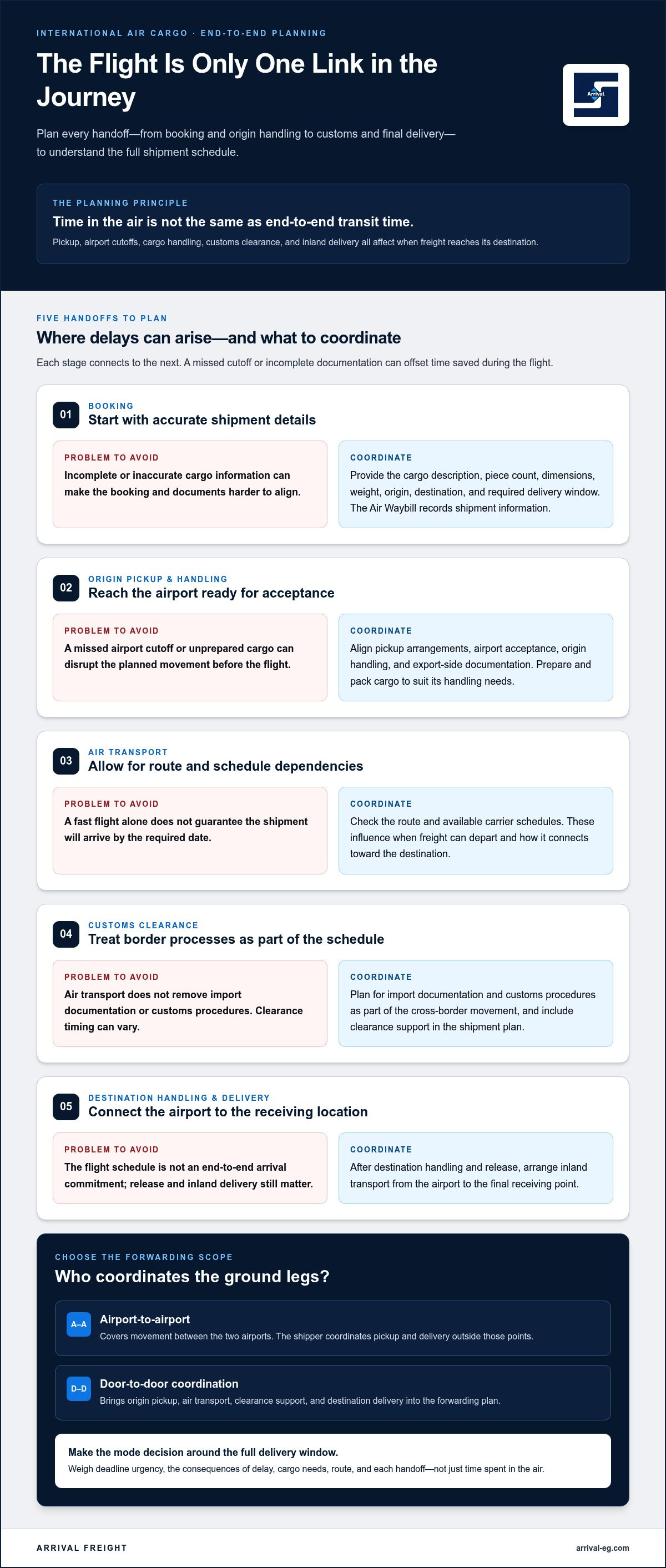
An international air shipment moves through connected handoffs, not just a flight. The plan starts with accurate booking information and ends when freight reaches the agreed delivery point. Routing, carrier schedules, origin handling, border processes, and inland transport all shape the actual transit time.
A typical international air shipment moves through booking, origin pickup and handling, air transport, customs clearance, and final delivery.
- Confirm booking details. Provide the cargo description, piece count, dimensions, weight, origin, destination, and required delivery window. These details help shape the routing and service plan.
- Coordinate origin handling. Arrange pickup if required, prepare the shipment for airport acceptance, and complete the export-side documentation and handling steps.
- Move the freight by air. The cargo travels on a scheduled carrier route. Routing and available schedules influence when it can depart and how it connects toward the destination.
- Coordinate customs clearance. Import documentation and customs procedures form part of the cross-border movement. Clearance timing depends on the shipment and border process.
- Arrange final delivery. After destination handling and release, inland transport can move the shipment from the airport to its receiving location.
Airport-to-airport service covers movement between the two airports, while the shipper coordinates pickup and delivery outside those points. Door-to-door coordination brings those ground legs into the forwarding plan, connecting origin pickup, air transport, clearance support, and destination delivery. Define the required service scope early so each handoff has a clear owner.
What happens before cargo reaches the airport?
Before freight moves, the forwarder aligns booking information, pickup arrangements, route requirements, and origin handling. The Air Waybill is a key air-freight transport document that records shipment information. Accurate cargo details help keep the booking and documents aligned. Prepare and pack the cargo to suit the shipment and its handling needs.
How do customs and destination delivery fit in?
Customs procedures are part of international transport, not a step that disappears because freight travels by air. Import and export documentation support connects the movement with clearance requirements. Once the shipment reaches its destination, inland transport links the airport to the final receiving point. Customs release and delivery timing can vary, so don’t treat the flight schedule as an end-to-end arrival commitment.
For a shipment plan that connects air movement with customs and inland coordination, explore Arrival Freight’s air-freight forwarding.
What international air cargo can and cannot control
Air freight can reduce the time goods spend moving between countries, but it can’t make every part of a shipment predictable. The flight is one link in a chain. Cargo still needs to be accepted and handled at origin, move on an available route, clear border processes, and reach its final destination.
That distinction matters when setting delivery expectations. Expedited service or planning around a scheduled carrier allocation can support a time-sensitive supply chain, but neither guarantees capacity on a particular flight or arrival on a specific date. A sound plan accounts for the full route and its dependencies, including steps outside the flight itself.
What advantages does air cargo offer?
For urgent replenishment or a critical commercial shipment, air transport can shorten international movement compared with slower modes. Scheduled carrier allocations help organize bookings against planned departures, while expedited and standard options let the transport plan reflect different priorities. Coordinating pickup, air movement, customs clearance, and final delivery also gives the shipper a connected view of the journey rather than treating the flight as the whole shipment.
- Speed: Air movement can help reduce the time needed to get priority goods between markets.
- Planning: Carrier schedules and allocations inform the shipment plan, while capacity and routing remain subject to operating conditions.
- Coordination: A forwarding plan can connect airport movement with origin pickup, clearance support, and inland delivery.
What can affect the planned transit?
Actual transit depends on the route and available schedules, as well as origin and destination handling, customs processes, and the ground legs around the flight. Cargo characteristics can also affect acceptance and handling requirements. Dangerous goods, including some shipments containing batteries, may be subject to specific air-transport rules. The International Air Transport Association’s Dangerous Goods Regulations address such requirements, so apply current guidance to the cargo and route.
- Routing and schedules: Connections and carrier availability shape when freight can move.
- Handling and cargo details: Dimensions, packaging, and cargo characteristics can affect acceptance or handling procedures.
- Border and delivery steps: Documentation, customs processing, and inland movement influence the full journey.
International air cargo offers speed and coordinated movement, not control over every handoff. Build the schedule around confirmed shipment details and current route requirements. Treat any arrival date as dependent on the complete transport and clearance process, not flight time alone.
How to assess whether air cargo fits your shipment
Make the decision against the full delivery requirement, not a general preference for speed. For international air cargo, start with the date the goods must arrive, then test the cargo profile, route, and delivery scope against that deadline. This gives you a practical basis for comparing transport plans without relying on unsupported transit-time or cost benchmarks.
Decision rule: Choose air when the shipment’s required delivery window and the cost of delay justify the route and handling plan.
- Set the deadline. Separate a required arrival window from a preferred one. Note what happens if freight arrives after each date, such as a production interruption, an unfilled order, or less scheduling flexibility.
- Describe the cargo. Gather dimensions, gross weight, commodity, and handling needs. Identify any special handling or temperature-control requirement because cargo characteristics can affect acceptance and the transport plan.
- Map the route. Record the origin and destination, including where pickup begins and where the shipment must ultimately be delivered. Airport access and inland movement are part of the plan.
- Define the service scope. Decide whether you need airport-to-airport movement or coordination that also covers pickup, customs support, and destination delivery.
These inputs help a forwarder assess routing and service options against the shipment’s priorities. Keep the delivery deadline, cargo details, and destination information consistent across booking and documentation. Missing or changing details can affect planning, so establish the shipment profile before comparing options.
Which shipment details shape the plan?
Dimensions and gross weight describe the physical shipment; commodity and handling needs add context for acceptance and movement. Pair those details with the origin, destination, and delivery window, then assess the consequence of delay. A preferred date allows more flexibility than a firm operational deadline. Flag special handling or temperature-control needs early so they can be considered in the route plan.
How should you compare service scope?
Airport-to-airport service focuses on air movement between airports. Door-to-door coordination can include origin pickup and destination delivery, with customs clearance support and inland connections integrated into the wider plan. Compare the included handoffs with the work your team can manage. For a quote, organize shipment dimensions, weight, commodity, origin, destination, handling needs, and required delivery window so the scope reflects the full journey.
Use this framework to shape the plan around your deadline and cargo requirements. Explore Arrival Freight’s air-freight forwarding for pickup, customs, and inland connections that fit your delivery scope.
Plan international air cargo with Arrival Freight
Plan the full shipment, not only the flight. Arrival Freight provides standard and expedited international air-freight forwarding, with service scope shaped around the cargo, route, and delivery priorities. Choose airport-to-airport movement when your team manages the ground legs. Choose door-to-door coordination when the plan needs to connect origin pickup, air transport, customs clearance, and delivery to the receiving location.
This joined-up view helps clarify responsibilities across handoffs. Scheduled carrier allocations inform the air-movement plan, while customs clearance support and inland connections link airport movement with the shipment’s final destination. The route and service scope can be shaped around shipment requirements, without treating flight time as the whole delivery schedule.
How does forwarding support simplify coordination?
Forwarding brings shipment details and transport stages into one coordinated plan. Arrival Freight arranges standard or expedited air movement around the shipment’s priorities and route requirements. Customs clearance and import/export documentation support sit alongside transport planning, while inland and intermodal connections can link the origin or destination airport with regional pickup and delivery points.
- Carrier movement: Scheduled allocations help inform the routing plan, subject to shipment and route requirements.
- Border coordination: Customs clearance support connects documentation needs with international movement.
- Ground connections: Inland transport links the airport legs to pickup and delivery locations.
What should you share to start planning?
Give the forwarder a clear shipment profile. Origin and destination identify the route. Cargo details help frame handling and transport requirements. Your required delivery window, shipment priorities, and any special handling or temperature-control needs help shape the service scope. Distinguish a firm operational deadline from a preferred arrival date, and include pickup and final-delivery locations if you need door-to-door coordination.
- Origin and destination, including pickup and receiving locations.
- Commodity, dimensions, gross weight, and number of pieces.
- Required delivery window and the priority behind it.
- Special handling or temperature-control requirements.
- Whether you need airport-to-airport movement or coordination across the full route.
Clear inputs make it easier to align the forwarding plan with the actual shipment. Review Arrival Freight’s international air-freight forwarding to plan your shipment.
Turn your shipping priorities into a clear plan
Make the next move practical. Before booking, align procurement, operations, and the receiving team on the delivery window and the impact of delay. Record who owns pickup details, shipment documentation, customs coordination, and final receipt. A shared brief helps teams make consistent decisions when another time-sensitive shipment arises, instead of treating each urgent request as an exception.
Use that brief to decide whether international air cargo supports the business need and to define what the shipment plan must cover from origin to destination. Arrival Freight can shape forwarding around your shipment priorities, from the selected air service to the connections required across the route.
Set the requirements and coordinate the next steps with Arrival Freight’s air-freight team.
Frequently Asked Questions
What is international air cargo?
International air cargo is freight transported by aircraft between countries, with the shipment arranged through an airline or freight forwarder. The forwarding plan can cover more than the flight: it may also coordinate airport handling, documentation, customs clearance, and ground transport. For example, a business sending replacement parts overseas can plan airport movement alongside pickup and delivery, rather than arranging each stage as a separate task.
Is international air cargo suitable for every type of shipment?
No. It can suit shipments with a firm delivery need, but suitability depends on the cargo, route, handling requirements, and consequences of delay. A small component needed to resume production may justify air transport, while bulky stock with flexible replenishment timing may fit another plan. Cargo acceptance requirements also vary with shipment details, so assess the commodity and handling needs before selecting a route.
How long does international air cargo take?
There isn’t one fixed transit time for every shipment. The route, carrier schedule, origin and destination handling, customs processing, and final delivery all affect the end-to-end plan. A direct flight and a shipment requiring connections have different routing steps, but flight duration alone does not establish a guaranteed delivery date. Use the lane-specific schedule and full delivery scope to plan around your required window.
How much does international air cargo cost?
The price depends on shipment-specific details and the route, so a general per-kilogram figure may not reflect the final quote. Provide accurate dimensions and gross weight, since both help describe the space and weight the shipment occupies. The commodity, handling needs, service scope, and destination also inform planning. For a useful quote, include whether pickup, customs support, or delivery beyond the airport is part of the requirement.
What documents are needed for international air cargo?
Documentation depends on the cargo, origin, and destination. The Air Waybill is a key transport document. Commercial invoices, packing lists, and other supporting paperwork may also be needed for customs processing, depending on the shipment and applicable requirements. Keep descriptions, quantities, and shipment details consistent across documents. Accurate information helps the shipment move through booking and border procedures with fewer avoidable questions.
Can international air cargo include door-to-door delivery?
Yes. Door-to-door logistics can coordinate movement from the pickup location through the destination delivery point, rather than limiting the plan to airport-to-airport transport. This scope can connect air freight with customs clearance support and inland or intermodal movement. For example, a shipper without transport arranged at either end can include those ground connections in the forwarding requirements.
Can temperature-sensitive goods travel by international air cargo?
Yes, temperature-sensitive goods can move through air freight when the shipment plan accounts for their handling requirements. Arrival Freight provides temperature-controlled logistics alongside air-freight forwarding. Share the required temperature range and handling priorities when planning so the shipment profile reflects the cargo’s needs. Acceptance and routing depend on shipment details and current requirements, so don’t assume every route handles every temperature-sensitive commodity in the same way.

