
The smaller shipment isn’t always the simpler choice. In FCL vs LCL shipping, container volume matters, but so do consolidation, cargo handling, timing, and the services needed around the ocean leg. If you’re deciding whether your cargo justifies a full container, comparing the options by volume alone can lead to the wrong decision.
LCL is often a starting point for smaller shipments, while FCL is often considered for larger ones. As a rough guide, FCL can become more cost-effective above 12 to 15 CBM, but that is not a universal cutoff. The right fit depends on the cargo, route, handling requirements, and services in the plan. LCL shares container space and requires consolidation and deconsolidation. FCL reserves a container for your shipment. Each option creates a different handling and planning process.
This guide compares FCL and LCL by shipment volume, cargo condition, schedule, and service needs. You’ll learn which shipment details to prepare, how the options move through the ocean-freight process, and how ocean transport can connect with inland transport and customs clearance. Base your decision on the full move, not container fullness alone.
Key Takeaways
- Choose between reserving container capacity and sharing space based on your cargo profile, not a single rule of thumb.
- Understand how FCL vs LCL shipping affects cargo handling and where consolidation fits into the shipment process.
- Compare the cost structures and planning requirements of each option using the same shipment details.
- Measure your cargo, set your priorities, and use those details to compare suitable shipping approaches.
- Coordinate ocean freight with inland transport and customs clearance as part of the wider shipment plan.
FCL vs LCL Shipping: What Each Option Means for Your Shipment
The first decision is how to use container capacity: reserve a container for your cargo, or share space with other shipments. That choice affects the cargo’s handling path, but it doesn’t determine the right option on its own. Start with what you need to ship, how it is packed, and how it must be managed from origin to destination.
What does FCL shipping mean?
FCL, or Full Container Load, means one shipper books a container for their cargo. The container does not have to be filled to capacity. A business might choose FCL for a shipment that takes up much of the available space, or when a dedicated container better fits its handling and delivery plan.
FCL still requires careful preparation. Pack the cargo for transport, organize shipment details and documents, and coordinate the movement from origin to destination. Booking the container is one part of the plan, not a substitute for these steps.
What does LCL shipping mean?
LCL, or Less than Container Load, combines cargo from multiple shippers in one container. For example, a business shipping a few pallets of components may share container capacity with other companies’ goods. Shipment volume is often described in cubic metres (CBM), a measure of the three-dimensional space the cargo occupies.
At destination, the shared cargo is separated so each shipment can move through its own release process. This consolidation model is the basis of Less-than-container load (LCL) shipping.
Think of FCL and LCL as different container arrangements, not a strict “large shipment versus small shipment” rule. With FCL, the container is allocated to one shipper’s cargo. With LCL, several shipments use the same container, and each shipper’s goods remain a separate consignment within that shared movement. Either way, the cargo must be identified, packed, documented, and coordinated correctly.
For a practical comparison, consider a business moving boxed machine parts. With FCL, the container is reserved for that business’s goods, even if some space remains unused. With LCL, the boxes travel alongside compatible cargo from other shippers, then are separated during destination handling. The suitable arrangement depends on the shipment’s dimensions and weight, the nature of the goods, delivery priorities, and handling requirements.
Before choosing a mode, gather accurate cargo information: package count, dimensions, total weight, and a clear description of the goods. Note any packing or handling needs, as well as the origin, destination, and preferred delivery arrangement. These details help shape a plan for the full movement, including ocean freight and any required inland transport or customs coordination.
Start with the shipment profile, then compare how each container arrangement fits your operational priorities. That gives you a sound basis for understanding the process and costs involved.
How FCL and LCL Shipments Move Through the Ocean-Freight Process
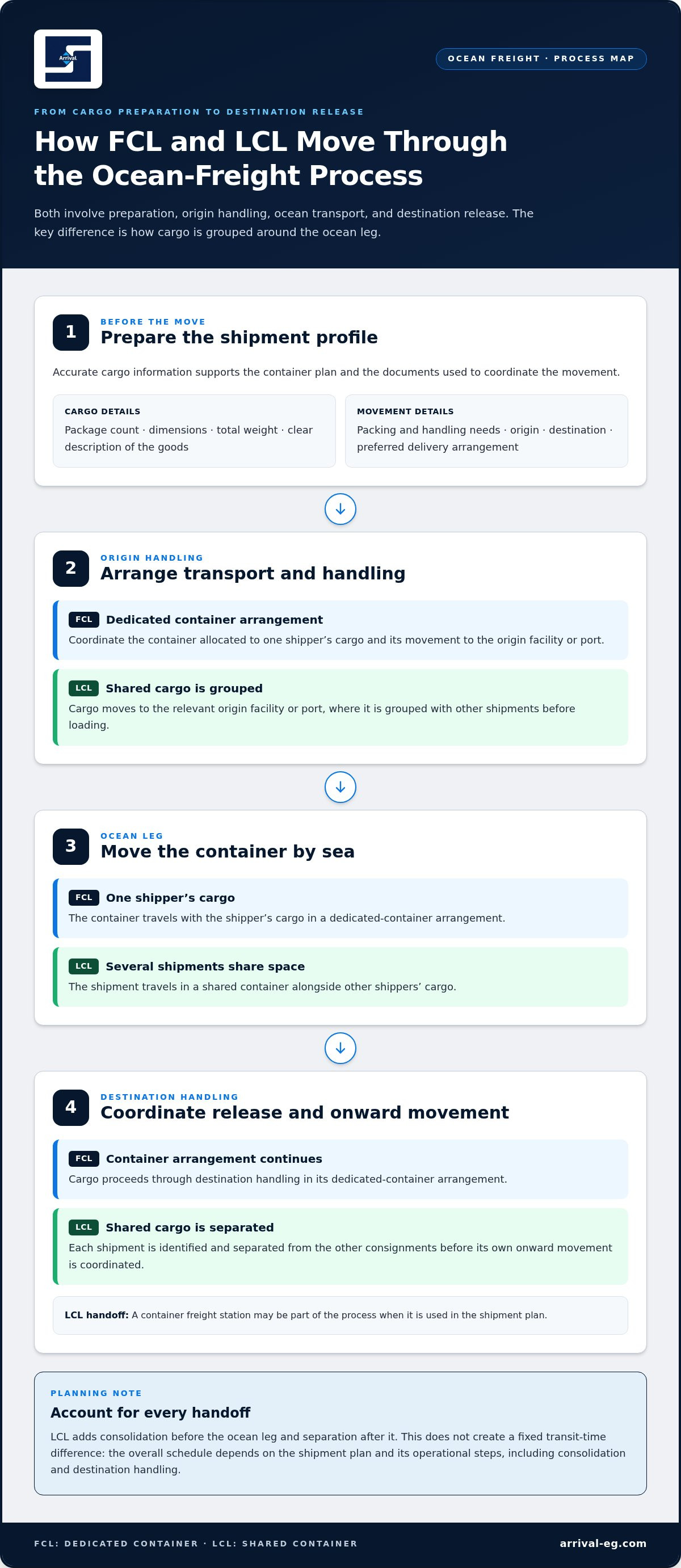
Both shipment types involve preparation, origin handling, ocean transport, and destination release. The main difference is how cargo is grouped around the ocean leg. FCL moves in a container allocated to one shipper’s cargo. LCL adds consolidation before that leg and separation after it. Map the full movement, including those extra handoffs, rather than focusing only on the vessel journey.
- Prepare the cargo. Confirm package count, dimensions, weight, packing, and shipment details. Accurate information supports the container plan and the documents used to coordinate the movement.
- Arrange origin transport and handling. Cargo moves to the relevant origin facility or port. An FCL plan coordinates the dedicated container and its movement. An LCL plan also groups cargo with other shipments before loading.
- Move the cargo by sea. The container travels as part of the ocean-freight leg. FCL cargo remains in its dedicated-container arrangement, while LCL cargo shares a container with other shipments.
- Coordinate destination handling and release. FCL cargo proceeds through destination handling in its container arrangement. LCL cargo is separated from other consignments before its own onward movement is coordinated.
Where consolidation and deconsolidation happen
For LCL, consolidation takes place before the ocean leg, when compatible shipments are grouped into a shared container. At destination, the cargo is deconsolidated: each shipment is identified and separated for its next handling or delivery step. A container freight station may be part of the process when used in the shipment plan. The facilities and handoffs depend on the movement being coordinated.
This distinction affects how teams plan around cargo status and delivery. With FCL, the container is handled as a single shipment unit for the shipper’s cargo. With LCL, the shipment goes through shared-container handling and a separation stage. This does not determine a fixed transit-time difference. The overall schedule depends on the shipment plan and its operational steps, including consolidation and destination handling.
How mixed FCL and LCL legs can work
A shipment’s container arrangement can change between transport legs. For example, cargo might travel with other shipments on an inland leg, then move in a dedicated container for the ocean leg. Another plan could use a dedicated container by sea, followed by separate onward deliveries at destination. These examples show how arrangements can vary. Each requires clear coordination wherever responsibility or handling changes.
At every handoff, align the shipment documents, cargo identification, status updates, and next transport step. If cargo moves from a shared facility to a dedicated container, account for that transition in the plan. If it is separated after arrival, coordinate onward movement to each shipment’s destination. FCL vs LCL shipping is one part of the routing decision, alongside inland and intermodal transport and customs clearance where these are part of the freight plan.
Build these connections into the shipment plan from the start. Coordinate ocean freight with inland transport as one connected movement, with each handoff defined around the cargo and its destination.
FCL vs LCL Comparison: Volume, Handling, Timing, and Cost Factors
A useful comparison looks beyond how much space the cargo occupies. Review how capacity is booked, where extra handling occurs, what the quoted service includes, and how the schedule fits cargo readiness. In FCL vs LCL shipping, the core distinction is straightforward: FCL books a container for one shipper’s cargo, while LCL shares container capacity among separate shipments. The operational and cost implications depend on the shipment and service plan.
| Factor | FCL | LCL |
|---|---|---|
| Container use | A container is booked for one shipper’s cargo, even if space remains unused. | Multiple shippers’ cargo shares container capacity. |
| Cargo handling | The shipment moves in its dedicated-container arrangement, with handling planned around that container. | Cargo is consolidated before ocean transport and separated from other shipments at destination. |
| Planning | Coordinate cargo readiness, container booking, documents, and connected transport legs. | Plan for the shipment’s consolidation and destination separation as well as its transport legs. |
| Cost structure | Costs are based on a container booking and the services included in the plan. | Cost allocation relates to the space the shipment occupies, alongside the services included in the plan. |
How shipment volume and cost structure affect the choice
CBM, or cubic metres, describes shipment volume. TEU, or twenty-foot equivalent unit, is a reference for container capacity. They serve different planning purposes: CBM describes the cargo’s space, while TEU expresses container capacity. A small or irregular consignment may suit shared capacity; a larger or more consistent flow may make a dedicated booking worth comparing. Neither measure alone selects the right mode.
Compare the full service scope, not just the headline freight line. Consider the booking, origin and destination handling, consolidation or separation where applicable, inland movement, and customs coordination if included. For LCL, understand how the shipment’s space is assessed. For FCL, compare the container booking with the services needed to move cargo from origin to destination. Use the same shipment details and service boundaries for both options.
How cargo handling and timing affect the choice
LCL includes handling to group shipments before the ocean leg and separate them after arrival. FCL avoids those shared-container consolidation and separation steps, but that does not make it universally faster or safer. Cargo type, packing, readiness, handling needs, and the planned service all matter. Set expectations against the schedule for the actual movement.
Before choosing, align cargo availability with the booking and transport plan. Compare the timing for each leg, including consolidation or destination handling in an LCL plan. Review equivalent origin and destination services, then weigh the handling sequence against the cargo’s requirements. This gives your team a practical basis for comparing options without relying on assumed transit times, blanket volume thresholds, or savings claims.
How to Decide Between FCL and LCL for Your Cargo
Make the choice in sequence: measure the shipment, rank your priorities, review the handling steps, then compare complete service plans. This prevents one factor, such as volume or urgency, from deciding the mode before you understand the full movement. A practical FCL vs LCL shipping decision should reflect both the consignment and its place in your inventory plan.
- Measure the cargo. Record package count, dimensions, total volume, and weight. Use the same cargo figures when comparing plans.
- Set your priorities. Identify the required delivery window, inventory needs, and any handling requirements that affect the shipment.
- Review the handling path. Account for shared-container consolidation and separation where relevant, plus inland transport and destination handling.
- Compare service plans. Assess the full scope, timing, and cost structure of each option, not just its ocean-freight component.
A practical FCL or LCL selection checklist
Prepare a concise shipment profile before comparing options. Include the cargo type and handling needs alongside the transport details. Clear inputs make service plans easier to compare and help expose missing steps before booking.
- Package dimensions, total volume, weight, and number of packages
- Cargo type and any packing or handling requirements
- Origin, final destination, and delivery location
- Cargo readiness date and required shipment dates
- Needed service scope, including inland transport and destination handling
Match the mode to the shipment scenario
Small replenishment: A limited batch of stock needed to fill a gap may fit shared capacity, particularly if the delivery plan allows for consolidation and separation. Larger shipment: A substantial or regular cargo flow may make a dedicated-container plan worth comparing, even if the container won’t be completely full. Mixed cargo flows: A business with varied suppliers or shipment sizes can assess each consignment on its own profile rather than forcing every movement into one mode.
Then test each option against your calendar. A tight delivery window can make the handling sequence and confirmed schedule more influential than shipment size alone. LCL requires time for consolidation and destination separation. FCL follows a different container plan, but neither label guarantees a particular arrival date. For recurring orders, compare shipment timing with stock levels and replenishment cycles. A mode that suits one consignment may not suit every order in the flow.
Once your cargo details are ready, plan an ocean freight shipment around the movement’s priorities and service requirements.
Coordinate FCL or LCL with Arrival Freight’s Ocean-Freight Services
Choosing FCL or LCL is one part of the freight plan. Arrival Freight coordinates ocean freight forwarding for both options, with port-to-port and door-to-door coordination. The plan can reflect where cargo enters the ocean network and what movement is needed before or after the port. Keep the whole shipment in view, from origin pickup through destination delivery.
FCL vs LCL shipping is easier to assess when the booking is considered alongside inland movement and customs clearance. A port-to-port plan focuses on the ocean leg between ports. A door-to-door plan can connect that leg with transport to or from the cargo’s origin and destination. Choose the scope based on the movement you need, not just the container arrangement.
Connect ocean freight with inland transport and customs
Inland and intermodal transport can link a cargo origin or destination with the relevant port, bringing land movement into the wider plan. Customs clearance supports the import or export process by coordinating the information and documentation involved. These elements connect to the ocean leg but remain distinct planning needs. Set out where cargo starts and ends, then identify the transport and clearance steps the shipment requires.
Arrival Freight is based in New Damietta, Egypt, and operates globally. For each shipment, the plan should follow its actual origin, destination, and required service scope.
Prepare the shipment information for a freight plan
Share clear cargo and timing details so the FCL or LCL option can be assessed as part of the complete movement. Separate fixed requirements, such as the cargo’s destination, from priorities, such as a preferred delivery window. Priorities guide planning; they are not guaranteed transit times or fixed service promises.
- Cargo dimensions: Provide package measurements and total volume.
- Weight: Include the shipment’s total weight.
- Commodity: Describe the goods and any relevant handling needs.
- Origin and destination: Identify where the cargo begins and where it must be delivered.
- Shipping dates: State when the cargo will be ready and any preferred shipping or delivery dates.
- Service scope: Note whether you need port-to-port or door-to-door coordination, plus inland transport or customs clearance.
With these details, Arrival Freight can plan the container arrangement alongside connected transport and clearance requirements. That makes for a more useful freight discussion, based on the cargo profile and the full route rather than an isolated ocean booking. Discuss your FCL or LCL shipment with Arrival Freight.
Turn Your Shipping Decision into a Clear Plan
Use your next booking to create a repeatable decision process. Record what matters for the cargo, delivery window, and inventory plan, then apply the same priorities to future shipments. This gives your team a consistent basis for evaluating FCL vs LCL shipping as demand changes, instead of relying on assumptions from a previous consignment.
Arrival Freight coordinates ocean freight forwarding for FCL and LCL within a broader shipment plan, with inland transport and customs clearance included where needed. Bring your cargo profile, origin, destination, readiness date, and delivery priorities to the discussion. Clear inputs help shape a plan around the actual movement and service scope you need.
Use the shipment details you’ve gathered to compare the full route, handling sequence, and service scope. Then choose the container arrangement that best fits your cargo and delivery priorities.
Frequently Asked Questions
Is FCL shipping always cheaper than LCL?
No. The better-value choice depends on the shipment’s size, route, handling requirements, and the services included in the plan. FCL books a container for one shipper’s cargo, while LCL allocates container space across multiple shipments. For a fair comparison, use identical origin and destination details and review the full service scope, including handling and inland movements. Compare shipment-specific plans rather than assuming either option will cost less.
Can I use FCL if my cargo does not fill a container?
Yes. FCL means booking a container for one shipper’s cargo, not filling every available space. A business might prefer a dedicated-container arrangement to align with its cargo plan or operational requirements. Unused capacity alone doesn’t make FCL unsuitable. Compare the dedicated booking with the LCL plan, including its handling stages, and choose the arrangement that best fits your shipment and delivery needs.
How much cargo do I need for FCL instead of LCL?
There’s no single volume cutoff that applies to every route and shipment plan. Measure the cargo in cubic metres, then record its weight, package count, and handling needs. For example, two consignments with similar volume may require different plans if their packaging or delivery priorities differ. Use your measurements to compare FCL and LCL for the specific movement. Treat general thresholds as reference points, not automatic booking rules.
Does LCL shipping take longer than FCL?
Not in every case. LCL involves consolidation before ocean transport and deconsolidation at destination, but the full schedule depends on the route, cargo readiness, and service plan. FCL avoids those shared-container steps, yet that alone doesn’t establish an arrival date. Work back from the required delivery date, account for cargo readiness and receiving arrangements, and compare the end-to-end schedules for each option.
Is LCL shipping suitable for fragile or sensitive cargo?
It depends on the goods, packaging, handling requirements, and applicable transport restrictions. Shared-container handling means the shipment is consolidated and later separated, so describe the cargo accurately and identify specific handling needs in the shipment plan. For example, provide packaging details and explain which handling conditions matter. Don’t assume LCL is automatically unsuitable or that choosing FCL guarantees protection. Assess the cargo’s actual requirements before selecting a mode.
What information do I need to compare FCL and LCL quotes?
Prepare package dimensions, total weight, package count, commodity description, origin, destination, and cargo readiness date. Include any special handling requirements and state whether inland transport or customs clearance should form part of the plan. Compare quotes with the same service boundaries: check what origin and destination handling each covers and whether the same transport legs are included. Consistent inputs make the comparison more useful than headline freight figures alone.
Can one shipment use both FCL and LCL?
Yes, a freight plan can use different container arrangements across separate legs or consignments when that fits the cargo flow. For example, a business may ship one order as FCL and a smaller follow-up consignment as LCL. Keep each shipment’s cargo records, documents, status, and handoff responsibilities distinct. A mixed arrangement isn’t automatically simpler or faster, so compare its coordination needs with using one container mode throughout.
Plan your FCL or LCL ocean-freight shipment with Arrival Freight, and include your cargo dimensions, origin, destination, and delivery priorities.

