
A fast flight can’t make up for a shipment stalled at a handoff. Cargo still has to move from pickup to the airport, through customs, and onward to its destination, with each stage aligned to the next.
Air freight services manage more than space on an aircraft. They coordinate cargo preparation, carrier arrangements, airport handling, customs clearance, and ground transport. The flight matters, but so does the plan around it. Clear coordination helps teams track progress and understand who is responsible at each stage.
This guide follows an air freight shipment from origin to delivery and explains how the steps connect. You’ll also see how airport-to-airport service differs from door-to-door logistics, and when scheduled air cargo, expedited shipping, or aircraft chartering may fit a shipment. Arrival Freight connects international air cargo with customs clearance and inland and intermodal transport, bringing key handoffs into one coordinated process.
Key Takeaways
- Air freight services coordinate more than the flight. They connect carrier planning with cargo handling and onward transport.
- Track shipment milestones to see where origin and destination handoffs need clear ownership.
- Compare scheduled cargo, expedited shipping, and chartering to identify a suitable coordination model for the shipment.
- Airport-to-airport service covers the air leg, while door-to-door logistics connects origin and destination transport.
- Arrival Freight brings air cargo together with customs clearance and inland and intermodal transport.
What Air Freight Services Include, and What a Forwarder Coordinates
Air freight services coordinate commercial cargo movement by aircraft and arrange the logistics that connect the flight with origin and destination. The airline operates the aircraft and carries cargo on its route. A freight forwarder plans the shipment around that air service, coordinating the handoffs that move cargo to the airport and onward after arrival. The roles work together, but they are not the same.
Air cargo transport moves commercial freight through an airport-to-airport or coordinated door-to-door logistics plan; parcel delivery typically moves individual packages through a parcel network. Air cargo can include consolidated commercial shipments and larger consignments, with handling and transport arrangements shaped by the cargo and agreed scope. The Air freight overview provides further background on cargo types and this mode of transport.
Service scope determines which stages are covered. Airport-to-airport logistics cover movement between the designated airports, while pickup, customs clearance, and delivery may be arranged separately. Door-to-door coordination connects origin pickup with destination delivery around the air leg. These options are not interchangeable: one focuses on airport endpoints, while the other links more of the journey.
What does an air freight forwarder coordinate?
A forwarder coordinates carrier bookings, aligns shipment milestones, and communicates with the parties handling cargo at each stage. Depending on the agreed scope, the plan may connect pickup, origin airport handling, the air movement, destination customs clearance, and inland delivery. The sequence depends on the route and service arrangement. Clear ownership helps each party understand what happens next and where a handoff takes place.
For example, a business shipping goods from its facility to an overseas buyer may need cargo collected, delivered to the origin airport, moved by air, cleared at destination, and transported to the buyer. A forwarder can coordinate these connected stages rather than treating the flight as the whole shipment. In an airport-to-airport arrangement, some ground transport or customs tasks may fall outside the agreed scope.
Which businesses use international air freight?
Manufacturers may use international air freight to move components between production locations or replenish stock. Distributors may arrange shipments to meet customer orders across markets. Businesses replenishing time-sensitive inventory can use air freight to connect supply with demand on a planned schedule.
The operational need is to move commercial cargo between locations, align the carrier booking with origin and destination handling, and make responsibilities clear. To define the service scope, set the pickup and delivery points, identify who manages customs and ground transport, and align those tasks with the planned air movement. This gives each stakeholder a clear role in the shipment plan.
How an Air Freight Shipment Moves from Origin to Destination
An air shipment is a sequence of connected handoffs, not just a flight booking. The forwarder aligns carrier space with cargo readiness, origin handling, destination arrangements, and the agreed delivery scope. A clear plan identifies each party’s role and shows how cargo moves from one stage to the next.
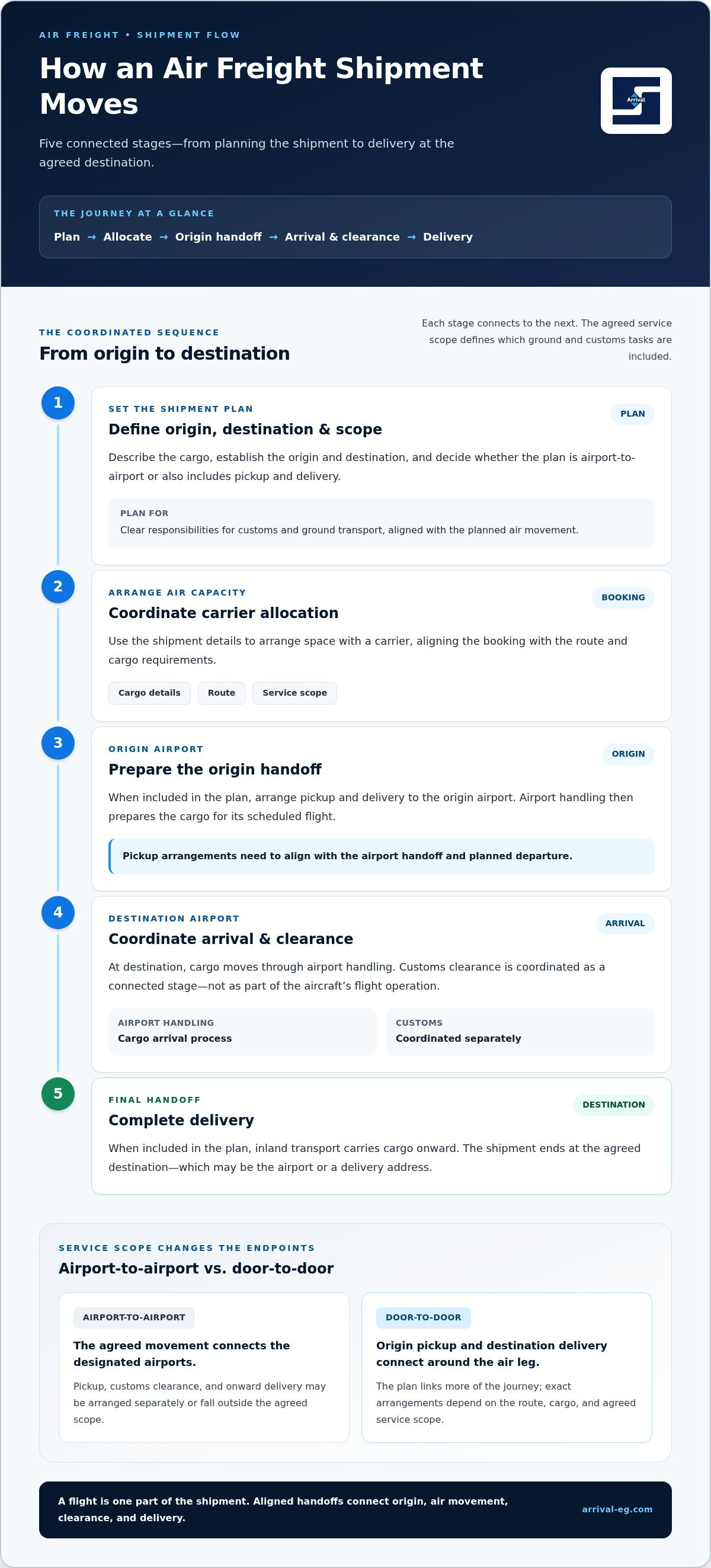
An air freight shipment is planned, allocated to a carrier, handed over at origin, flown to destination, cleared through customs, and delivered according to the agreed service scope. Customs clearance and ground transport support the shipment around the air movement. They are separate from the aircraft’s flight operation.
- Plan the shipment. Set the origin and destination, describe the cargo, and establish whether the plan covers airport-to-airport movement or includes pickup and delivery.
- Coordinate carrier allocation. Use the shipment details to arrange space with a carrier, aligning the booking with the route and cargo requirements.
- Prepare the origin handoff. Arrange pickup and delivery to the origin airport when included. Airport handling then prepares the cargo for its scheduled flight.
- Coordinate arrival and clearance. At destination, the cargo moves through airport handling. Customs clearance is coordinated as a connected stage, not as part of the flight.
- Complete delivery. Inland transport carries the cargo onward when included in the plan. The shipment ends at the agreed destination, which may be the airport or a delivery address.
From booking coordination to departure
Shipment details shape the carrier arrangement and origin plan. Cargo description, route, and service scope help determine how the booking and handling are coordinated. The forwarder connects carrier allocation with the origin handoff, directing cargo to the appropriate airport process before departure. Any pickup arrangements must align with that handoff and the scheduled flight. Cut-off times and transit durations vary by shipment and route, so don’t assume one standard schedule.
From arrival airport to final delivery
Arrival is another coordinated handoff. Cargo is handled at the destination airport, then customs clearance and inland transport are arranged according to the service scope. In an airport-to-airport plan, the contracted movement ends at the destination airport; onward delivery is separate unless included in the arrangement. A door-to-door plan connects origin pickup and final delivery with the air leg. The route, cargo, and agreed arrangements determine the exact sequence.
For time-sensitive shipments, map the handoffs before cargo moves. Identify who coordinates origin pickup, airport handling, customs, and final transport, then align those responsibilities with carrier milestones. Arrival Freight coordinates international air cargo with customs clearance and inland and intermodal transport. Explore coordinated air freight services for a plan that connects the journey from origin to destination.
Air Freight Service Models: Scheduled Cargo, Expedited Shipping, and Charter
Air freight services can be arranged in different ways to suit a shipment’s timing needs, cargo profile, and planning requirements. Scheduled carrier allocations use planned air cargo capacity. Expedited services address tighter timing requirements. An aircraft charter is a separate arrangement built around a specific shipment or operational need. The model shapes how capacity is coordinated, not just how quickly cargo moves.
Use this comparison to identify the main differences:
| Service model | Coordination approach | Typical operational use | Planning flexibility |
|---|---|---|---|
| Scheduled cargo | Forwarder coordinates cargo with planned carrier allocations. | Standard international shipments that can move within scheduled air cargo capacity. | Planning follows available carrier schedules and shipment readiness. |
| Expedited shipping | Forwarder coordinates an air cargo arrangement around tighter shipment timing needs. | Time-sensitive replenishment or cargo that needs priority planning. | Requires focused coordination around the shipment’s timing and route. |
| Aircraft chartering | A dedicated aircraft is arranged for the shipment. | Project cargo, heavy-lift freight, or bulk shipments. | Can be customized around cargo and schedule requirements. |
When scheduled or expedited air cargo fits
Scheduled carrier allocations suit shipments that can be planned around available air cargo capacity. The forwarder aligns shipment readiness, booking coordination, and origin arrangements with the carrier plan. Expedited service is intended for tighter timing requirements and may call for a different coordination approach. It does not mean a fixed delivery window or guaranteed arrival. Choose the service based on the shipment’s timing needs and the arrangements for its route.
When aircraft chartering supports specialized cargo
Chartering arranges a dedicated aircraft rather than routine cargo space on scheduled carrier allocations. It can support project cargo, heavy-lift freight, and bulk shipments when the cargo and schedule call for a tailored plan. The charter is coordinated around the shipment’s requirements, including the operational arrangements needed to move the cargo. This is a distinct planning model, not a universal transit-time promise.
To assess the options, define the shipment’s timing requirement, cargo characteristics, and planning constraints. Then compare scheduled capacity, expedited service, and a dedicated aircraft charter. A tighter timing need may call for expedited coordination; specialized project or handling needs may require charter planning. Choose a model that fits the operational requirement and the full shipment arrangement, including origin and destination logistics.
Keep Air Freight Coordination on Track Across Shipment Milestones
A shipment can lose momentum when responsibility becomes unclear between handoffs. Identify who owns each transition, what update marks progress, and who should be contacted if the plan changes. A shared view of the journey helps teams avoid communication gaps and coordinate the next step.
Which shipment milestones should teams follow?
Record each milestone alongside the responsible party and the expected update. Keep the details in one shared shipment record so the team can see what has happened and what comes next. Handoffs vary by route and agreed scope, but these checkpoints provide a practical framework.
- Origin handoff: Record when cargo is transferred for the planned airport handling and who manages the transition.
- Departure: Note confirmation of the flight movement and who is responsible for sharing the update.
- Arrival: Track confirmation that cargo has reached the destination airport and identify the next handling contact.
- Customs clearance: Assign responsibility for coordinating clearance and communicating any required next steps.
- Delivery: Confirm who arranges onward transport, the intended delivery point, and how completion will be reported.
Set expectations before cargo moves. Specify whether updates are expected at departure and arrival, and who will relay them to the receiving team. Clear ownership is especially important at transitions, where the airline, airport handlers, customs contacts, and ground transport parties may each manage a different part of the journey.
How customs and inland transport affect the shipment journey
Air transport connects origin and destination airports. Customs clearance and onward trucking or intermodal transport connect the airport movement to the wider delivery plan. Clearance timing depends on shipment details and applicable border processes, so treat it as a distinct milestone rather than assuming cargo can move straight from arrival to delivery. Keep the customs and inland transport owners aligned on the destination handoff.
Plan for exceptions without assuming a particular recovery outcome. Agree who communicates a schedule change, who coordinates the next handoff, and how the receiving team will be updated. If cargo is held at an airport or a planned connection changes, a defined communication path helps stakeholders assess the next step. It does not guarantee a particular resolution, but it helps prevent conflicting assumptions.
Use a shipment checklist to keep responsibilities visible, then align each update with the agreed service scope. Arrival Freight coordinates air freight services with customs clearance and inland and intermodal transport, connecting the airport movement with onward logistics. Explore coordinated air freight support to plan the handoffs across your shipment journey.
Arrival Freight Air Freight Services Connect Global Cargo to Its Destination
A shipment’s flight is only one part of its journey. Arrival Freight coordinates standard and expedited international air cargo, connecting carrier arrangements with the logistics needed before departure and after arrival. The shipment plan can cover its agreed scope, from airport-to-airport movement to door-to-door coordination.
That connection matters at handoffs. Cargo may move from an origin location to an airport, through the air leg and destination handling, then through customs clearance and onward inland transport. Coordinating these stages helps align the plan and clarify who is responsible for each transition. The shipment and service scope determine the specific arrangements.
How Arrival Freight connects air, customs, and inland logistics
Arrival Freight’s air freight services include scheduled carrier allocations, standard and expedited international cargo, and airport-to-airport or door-to-door logistics. Customs clearance can be coordinated alongside air transport, while inland and intermodal services connect airports with origin or destination points. These services bring key transport stages into one logistics plan rather than treating the flight as the entire shipment.
For example, a shipment moving between a supplier’s facility and a buyer’s location may need origin transport to the airport, air cargo arrangements, destination clearance, and onward inland delivery. Airport-to-airport service focuses on the air movement between the airport points. Door-to-door coordination connects origin and destination logistics around that movement. Choose the scope based on where the cargo starts, where it needs to finish, and which stages need coordination.
For project cargo, heavy-lift freight, and bulk shipments, Arrival Freight also arranges aircraft chartering. A dedicated charter is distinct from scheduled carrier allocations and can be coordinated around cargo and schedule requirements.
Plan the next step for your air cargo
Start with a clear shipment brief. Include the information needed to shape the transport plan and identify the required handoffs:
- Origin and destination: Provide the pickup location, destination, and relevant airport points.
- Cargo profile: Describe the shipment, including whether it involves project, heavy-lift, or bulk cargo.
- Timing needs: Explain the planned shipment schedule and whether standard or expedited air cargo is required.
- Service scope: Indicate whether the plan should cover airport-to-airport movement or connect pickup, customs clearance, and inland delivery.
Arrival Freight tailors logistics arrangements to shipment requirements, coordinating air cargo with customs clearance and inland and intermodal transport. Share your origin, destination, cargo profile, timing, and required scope to begin planning. Discuss your air freight shipment.
Put Your Next Shipment Plan in Motion
A clear brief gives your logistics partner a practical starting point. Identify what the shipment needs to achieve, which dates matter, and where coordination could become complicated. Flag unusual cargo requirements, dependencies between teams, and destination handoffs that need attention.
Use those priorities to shape the air freight services plan. Separate essential requirements from preferences, and clarify which stages your team will manage and which need coordination. This turns a broad shipping request into practical decisions about service scope and milestones.
Start with the details you already have. Arrival Freight tailors arrangements to shipment requirements and helps define the next steps. Bring your shipment priorities into the conversation, then discuss your air freight shipment.
A well-defined plan gives every handoff a clear purpose and helps keep the cargo journey organized from the start.
Frequently Asked Questions
What are air freight services?
Air freight services coordinate commercial cargo transport by aircraft, with forwarding support that may connect origin handling, airport movement, customs coordination, and destination delivery. A freight forwarder organizes shipment stages and communicates with the parties involved; the airline operates the flight. The scope depends on the service arrangement, so pickup or final delivery may be included or handled separately. This is freight forwarding for commercial cargo, not the handling of passenger baggage.
How much does air freight cost?
Air freight cost depends on the route, shipment weight and dimensions, cargo characteristics, service level, and required handling or delivery scope. A quote may use chargeable weight, comparing actual weight with dimensional weight under applicable carrier rules. For example, a light but bulky consignment may be assessed differently from a compact, heavier one. Provide accurate dimensions, weight, cargo details, and destination information so Arrival Freight can plan the logistics arrangement for the shipment.
Can air freight be door-to-door?
Yes, door-to-door air logistics can connect pickup, airport handling, flight movement, destination arrangements, and final delivery. Airport-to-airport service covers a narrower part of the journey, with pickup and delivery outside that scope unless arranged separately. Customs clearance and inland transport are distinct operational stages coordinated around the air movement. For example, a shipment may need a truck from the arrival airport to a receiving facility. Inclusions and delivery timing vary by arrangement.
What is chargeable weight in air freight?
Chargeable weight is the weight carriers use to assess a shipment under their applicable rules. They may compare actual gross weight with dimensional weight, which reflects the space cargo occupies relative to its mass. The applicable chargeable weight depends on those measurements and the carrier’s method. Accurate packaging dimensions matter: a large carton can take up considerable cargo space even if its contents are relatively light. Confirm measurements as part of shipment planning.
Can dangerous goods be shipped by air freight?
Some dangerous goods can move by air, but only when applicable classification, packaging, documentation, and carrier acceptance requirements are met. Restrictions depend on the substance, route, and governing rules, so acceptance for one shipment does not establish that another is acceptable. Identify the goods accurately at the planning stage and arrange appropriate review of requirements. This overview is not a complete compliance guide or a substitute for shipment-specific requirements.
What happens if an air freight shipment is delayed?
A delay may result from operational, weather, handling, or border processes, and its impact depends on where it occurs in the journey. The forwarder coordinates relevant parties and next steps according to the shipment arrangement, but a particular recovery, rebooking, or delivery outcome cannot be assumed. For time-sensitive cargo, build contingency time into inventory and receiving plans. Also identify who should share updates with your team if a milestone changes.
What documents are commonly used for air freight?
An air waybill is a key transport document, while commercial and customs documents depend on the goods, origin, destination, and transaction. Paperwork may differ between shipments, even on a similar route, particularly when cargo or trading circumstances differ. Requirements can also vary by route and cargo type. Treat document preparation as shipment-specific and align paperwork with the parties coordinating transport and clearance rather than assuming one universal document set.

